
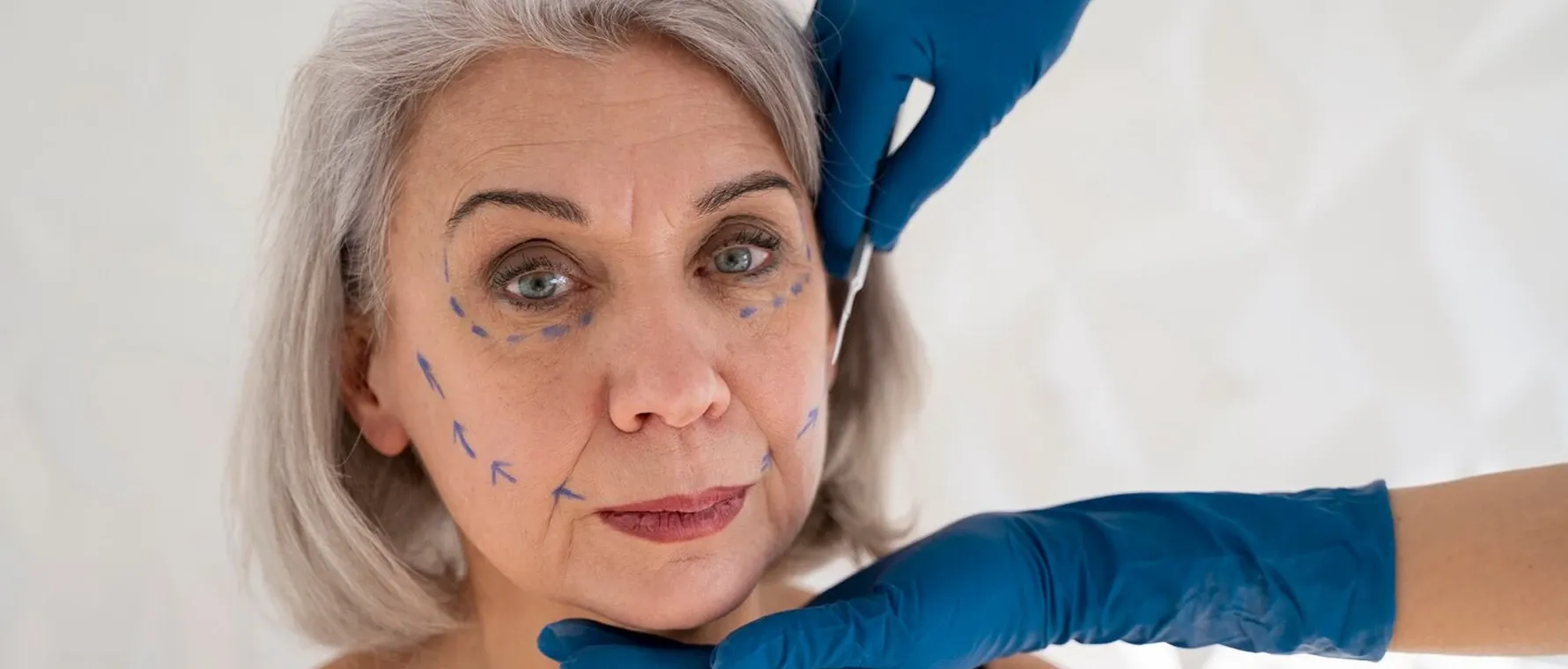
Time leaves its marks on all of our faces. When the effects of the sun, daily stress, our genetic heritage and the relentless force of gravity combine, our skin loses elasticity, wrinkles deepen and the youthful triangle of our face is inverted. The cheeks lose their volume and sag downwards, the jawline loses its clarity, the grooves on the sides of the nose and mouth (nasolabial lines) become more pronounced and the neck area becomes slack.
Although non-surgical methods such as fillers, botox and thread suspension are successful in camouflaging and delaying early signs of aging, they are the gold standard and the most effective solution for moderate and advanced sagging and volume loss. Facelift Surgery‘(medically known as Ritidectomy).
As Dr. Alper Eskalen, we do not see facelift surgery only as stretching the sagging skin. We consider this operation as a three-dimensional artistic procedure that moves the deep tissues of the face (SMAS layer) to the youthful position it should be, replaces the lost volume and ultimately provides a natural, rested and restored appearance.
Facelift Surgery is Not Just a “Lift”
Modern facelift surgery takes a much more sophisticated approach than it did 20 years ago. Techniques that used to only stretch the skin and thus cause a “taut” and “surgical” expression have now been abandoned. The most effective approach today is the SMAS (Superficial Musculoaponeurotic System) called the muscle and connective tissue layer.
The SMAS layer is the main support system of the face. With age, this layer loosens and slides downward with gravity, which causes the skin to sag. In an effective facelift surgery:
- SMAS Layer is Removed and Tightened: This deep tissue under the skin is moved and stabilized in the higher and further back position it should be. This is the most important step that fundamentally corrects sagging in the middle and lower part of the face.
- Excess skin is removed: Once the deep tissues are moved to where they need to be, the loose skin on the surface is gently laid down and the excess is removed, without creating any tension. This ensures a natural and “unstretched” result.
- Volume Restoration: If necessary, fat from the patient's own body can be injected into areas that have lost volume, such as the cheeks and cheekbones (fat grafting). This restores the youthful fullness and “heart shape” to the face.
Which Problems Does Facelift Surgery Solve?
A comprehensive facelift surgery (often combined with a neck lift) effectively addresses the following problems
- Mid Face Sagging: Cheeks that have fallen and lost volume.
- Deep Wrinkles Nasolabial grooves descending from the sides of the nose to the corners of the mouth and “marionette” lines descending from the sides of the mouth to the chin.
- Jawline Loss: A jaw line that has lost its clarity due to sagging jaw edges known as “jowl”.
- Neck Sagging Loosened neck skin and vertical bands, the so-called “turkey neck”.
Who is a Good Candidate for Facelift Surgery?
- Significant sagging and deep wrinkles on the face and neck,
- Who thinks that non-surgical methods are now insufficient,
- In good general health and non-smokers (or able to quit before surgery),
- Men and women between the ages of 45 and 65 with realistic expectations are usually the ideal candidates.
Recovery Process and Persistence of Results
Facelift surgery is performed under general anesthesia. Swelling and bruises on the face after surgery are expected. These effects are most pronounced in the first week and decrease significantly within 2-3 weeks. Patients can usually return to their social life after 2 weeks.
The surgical scars are hidden in the natural folds inside the hairline, in front of and behind the ears, making them almost imperceptible over time.
Facelift surgery doesn't stop time, but it does stop the clock It sets it back by about 10-15 years. The resulting rejuvenated appearance lasts for many years. Even years later, you will always look younger than you would have looked without surgery.
As Dr. Alper Eskalen and his team, we aim to achieve the most natural, fresh and personalized results by analyzing each patient's facial anatomy and aging pattern in detail.